
EcoloxTech manufactures hypochlorous acid for other people’s brands. Two quite different products sit under that one sentence, and deciding which you need is the first step in any private-label project — it sets the formulation, the packaging, the testing, the paperwork, and above all what your label is allowed to say.
Why brands come to a generator manufacturer for liquid
Hypochlorous acid has become a mainstream ingredient in facial mists, eye-care, post-procedure aftercare, acne and eczema products and premium pet care. The market has grown faster than the manufacturing base behind it, and a great deal of what is sold as cosmetic-grade HOCl is, on inspection, general-purpose sanitiser in an attractive bottle.
The difference is not marketing. It is the water, the salt, the cell, the pH control and what happens to the liquid after it leaves the cell. We have spent our engineering life on exactly those variables, because they are the same ones that determine whether an industrial generator holds its specification for a decade.
The result is a liquid built for skin contact rather than one that merely tolerates it.
Two lanes: decide this first
Everything else follows from this choice, so it is worth making deliberately rather than discovering it after the artwork has been printed.
| Lane 1 — EPA-registered disinfectant | Lane 2 — cosmetic & personal care | |
|---|---|---|
| What you get | HOCl-AS200, EPA Reg. No. 101112-1, sold under your own brand through supplemental distribution | Ultra-pure cosmetic-grade solution, manufactured to a specification agreed with you |
| What you may claim | Exactly the claims on the accepted label — the named organisms at the named contact time, on hard non-porous surfaces | Cosmetic claims only: cleansing, soothing, refreshing, conditioning. No antimicrobial, disease or pesticidal claims |
| Formulation | Fixed as registered. Concentration, pH, fragrance and colour cannot be changed | Specified with you: available chlorine, pH 5.0–6.5, ORP above 800 mV, format and fill |
| Testing that comes with it | The efficacy data behind the registration | HRIPT non-irritating and non-sensitising, formulated non-cytotoxic, and stability data |
| Carried in your name | State pesticide registrations, most renewed annually | MoCRA facility registration and product listing in the US; responsible person, product information file and safety assessment in the EU |
If you are not sure which lane you are in, describe the claim you want on the front of the bottle. The claim decides the lane, not the chemistry. What a turnkey programme actually involves walks through that decision and everything that comes after it.
Lane 1 — the EPA-registered disinfectant, under your brand
If your product needs to say that it kills or controls micro-organisms, it has to be a registered antimicrobial pesticide. Ours is HOCl-AS200, EPA Reg. No. 101112-1, label accepted 10 December 2025, manufactured at EPA Est. No. 101112-FL1.
That registration is available to you under your own brand name through supplemental distribution. The registration and the manufacturing stay with us; the brand name, and the name and address on the label, become yours. You get a registered disinfectant on shelf without running a multi-year registration programme of your own. In exchange the formulation is fixed exactly as registered, and so are the claims — the accepted label’s organism list is the whole of what you may say, on the bottle and on your website alike.
The detail, including what you may and may not change and the state registrations that will set your launch date, is in white-labelling an EPA-registered disinfectant.
Lane 2 — cosmetic and personal care
If your product is a facial mist, a toner, lid hygiene, post-procedure aftercare, pet or equine care, or a clinic bulk line, you are in the cosmetic lane, and what you are buying is purity and consistency rather than a registration. The rest of this page is that grade — the specification, what additive-free actually buys you, the hydrogel, the formats and how a programme runs. The companion article is white-label HOCl for cosmetics and personal care.
Specification
| Parameter | Ultra-pure cosmetic grade |
|---|---|
| pH | 5.0–6.5 (near-neutral, skin-compatible) |
| ORP | >800 mV |
| Water | Double-filtered RO/DI |
| Acid input | Pharmaceutical-grade aqueous hydrochloric acid |
| Salt input | USP-grade sodium chloride, heavy-metal free |
| Additives | None — no fragrance, surfactant, stabiliser or preservative |
| Irritation testing | HRIPT-validated: non-irritating, non-sensitising |
| Cytotoxicity | Formulated to be non-cytotoxic |
| Contact suitability | Skin, mucosal and ocular contact |
| Shelf life | Chlorine retention data over 24 months at room temperature |
| Optional | Nitrogen-blanket sealing for preservative-free extended life |
What “additive-free” actually buys you
Most stabilised HOCl products on the market contain something to hold the chemistry together — a buffer, a preservative, occasionally a surfactant. Each of those additions is a molecule your customer’s dermatologist did not ask for, and each is a potential irritant, a potential incompatibility and a line on an INCI list that a discerning buyer will question.
Producing a liquid that holds its specification without additives is harder. It requires purer inputs, tighter pH control, better containers and, for the longest shelf lives, displacement of headspace oxygen. That is the trade we have chosen to make, and it is why the stability data is worth reading rather than merely citing.
The hydrogel: the same chemistry, held in place
A liquid runs off the moment it is applied. On a vertical surface, on a wound margin, on a lid line, most of the dose is gone before it has done anything — and with an oxidising active, dose only matters for as long as it stays in contact. The hydrogel carries the same precision-electrolysed HOCl as the ultra-pure liquid, in a stabilised matrix that turns a dose into a dwell time.
The difficulty is the gelling system itself. Most cosmetic gels are thickened with organic polymers — carbomers, cellulose derivatives, gums — and every one of them presents an oxidisable backbone to the active it is carrying. The HOCl begins consuming the thickener the moment the two are combined, which is why so many gelled HOCl products lose their available chlorine long before their stated shelf life. We use an inorganic matrix with nothing for the active to attack.
| Parameter | Ultra-pure hydrogel |
|---|---|
| Available chlorine | 200–600 ppm |
| pH | 5.0–6.5 (near-neutral, skin-compatible) |
| Gel matrix | Stabilised inorganic — no oxidisable polymer backbone |
| Additives | None — no fragrance, surfactant, stabiliser or preservative |
| Irritation testing | HRIPT-passed |
| Formats | Roller, tube and jar |
| Chemistry | Identical to the ultra-pure liquid grade |
A note on how to read the numbers: concentration is the specification buyers ask about, but pH is the one that determines what the concentration is worth. Hypochlorous acid is the active species, and the proportion of free chlorine present as HOCl rather than hypochlorite collapses as pH rises. A 600 ppm product at pH 8 carries less usable active than a 200 ppm product held at 5.5. That is why the pH window is specified as tightly as the ppm range, and why both appear on the certificate of analysis.
Product formats we manufacture
Facial mists & toners
Fine-mist atomisers for daily-use hydrating and clarifying sprays. The largest single category in the HOCl skincare market.
Eye-care & lid hygiene
Formats for blepharitis and lid-margin hygiene, where non-cytotoxic, preservative-free and ocular-contact-safe are non-negotiable.
Post-procedure aftercare
Aesthetic clinics, tattoo studios, microneedling and laser aftercare, where the alternative is usually alcohol or an antibiotic ointment.
Acne & eczema support
Leave-on formats for sensitive and compromised skin where conventional actives are poorly tolerated.
Pet & equine care
Wound rinse, ear and paw care, hot spots and grooming. A fast-growing premium category.
Professional & clinic bulk
Larger refill formats for salons, clinics and veterinary practices dispensing at volume.
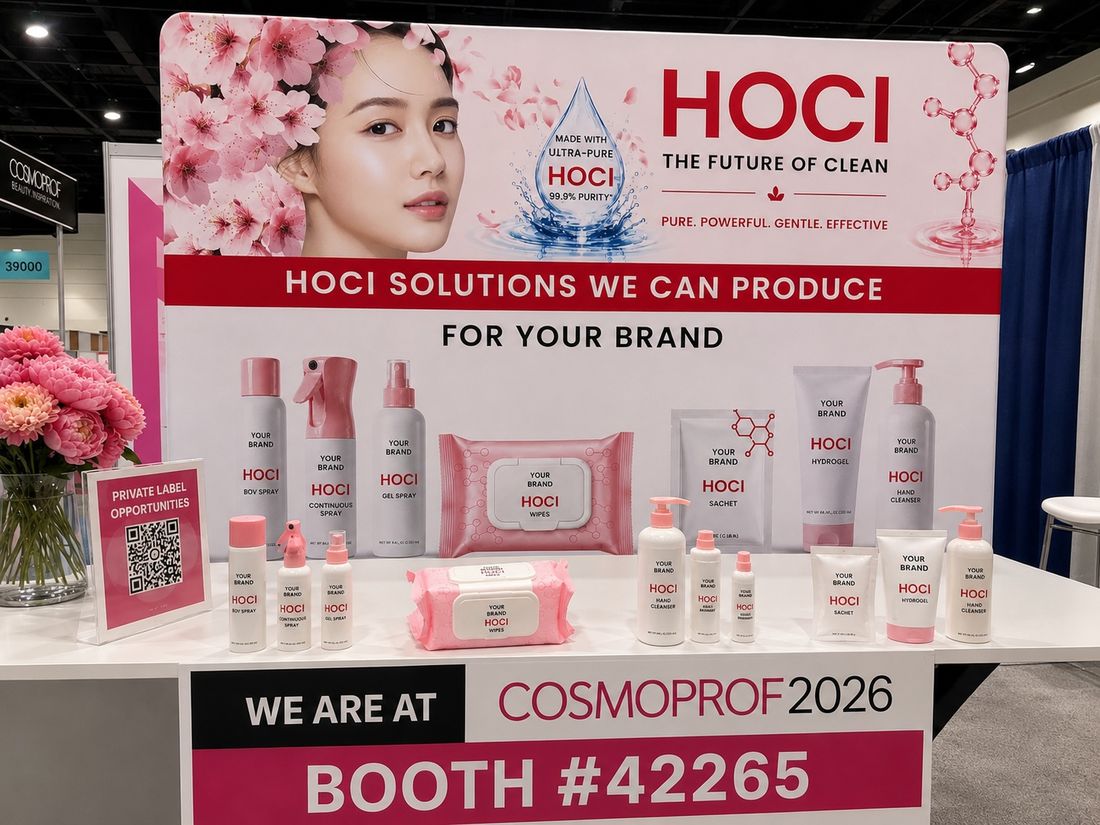
How the programme works
- Discovery. Your format, target concentration, packaging preference, annual forecast and target market. If you already sell an HOCl product, send us the current specification.
- Specification. We confirm the grade, concentration, pH window and packaging, and identify anything in your target market’s regulatory expectations that shapes the build.
- Samples. Bench samples in your chosen format for evaluation and, where you want it, your own third-party testing.
- Packaging. Stock components or your supplied components. Fine-mist atomisers, eye-care formats, trigger sprays, refill sizes. Nitrogen blanketing specified here if required.
- Documentation. Certificate of analysis, specification sheet, SDS, stability data and the HRIPT record.
- Production. Scheduled runs against your forecast, with agreed lead times and reorder points.
Scope of the ultra-pure grade
This grade is manufactured for cosmetic, dermatological, ophthalmic and other non-regulated topical use. It is not supplied for pesticidal claims, sterilisation or medical device claims. If your product needs a registered pesticidal claim, that is a different regulatory pathway — and one we also run. HOCl-AS200 (EPA Reg. No. 101112-1) is available under your own brand through supplemental distribution; see how that works.
Why manufacture with us specifically
- We build the generation equipment. The cell technology producing your liquid is our own, not a bought-in system we operate to someone else’s instructions.
- Control of the whole chain. Water treatment, input grade, cell chemistry, pH control, filling and sealing sit under one roof, so a specification deviation has one owner.
- Evidence behind the ingredient. Our research library is the largest consolidated HOCl literature collection in the industry — useful when your marketing team, your regulatory consultant or a retail buyer asks for substantiation.
- Additive-free is our default, not a premium option we upsell.
- You own the brand. We do not compete with our contract customers in their retail channels.
Start an enquiry
Tell us what you are building. We will come back with a specification, indicative pricing and a realistic schedule.
Questions
What is your minimum order quantity?
MOQs depend on format, packaging and whether the run uses stock or custom components. Tell us the format, fill volume and annual forecast and we will come back with tiered pricing. Development and sampling runs are handled separately from production MOQs.
Can you match a formulation we already sell?
In most cases yes. Send us your current specification — concentration, pH, ORP, packaging and any stability or irritation data you hold — and we will confirm whether we can match or improve it before you commit to anything.
Do you supply the packaging?
We can supply stock packaging or fill into components you specify and supply. Fine-mist atomisers, trigger sprays, eye-care formats and larger refill formats are all standard. Nitrogen-blanket sealing is available where extended preservative-free shelf life matters.
What documentation comes with production?
Certificate of analysis per batch, specification sheet, safety data sheet, stability data, and the HRIPT validation record. For customers selling into regulated channels we will supply what your own regulatory consultant asks for wherever we hold it.
Can you make claims on our label?
We manufacture; you own the brand and the claims. Cosmetic claims are your responsibility to substantiate in your market. Note that our ultra-pure grade is produced for cosmetic and non-regulated topical use — it is not for pesticidal, sterilisation or medical claims. Where a pesticidal claim is needed, that is a registered-product conversation and points to HOCl-AS200.
How long does it take to get to first production?
Typically: specification agreed, samples produced and approved, packaging confirmed, then a production run scheduled. The variable is almost always packaging lead time rather than the liquid. We will give you a dated schedule with the quote.
Do you also private-label the generators?
Equipment OEM and distribution arrangements are handled separately from liquid contract manufacturing. If you are interested in both, say so in your enquiry and we will structure one conversation.